
Written by Trigrammatic on behalf of the Dreel Burn Investment Readiness Partnership.
Project Overview
Project Summary
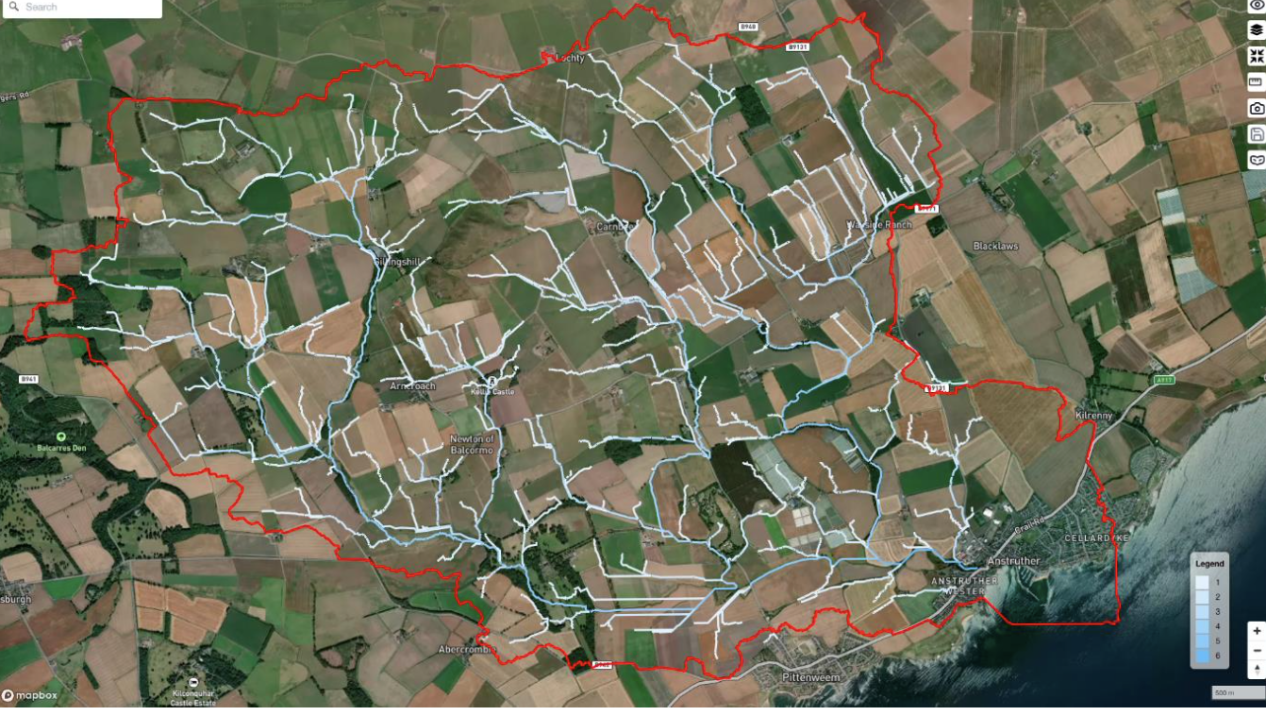
Focused on the Dreel Burn catchment in the East Neuk of Fife, and part of a wider roadmap to launch Nature Finance Fife (a regional blended finance programme for nature based solutions), our Phase 3 project extension was undertaken over the financial year 2025/26 (FIRNS funding commenced June 2025).
It was structured around achieving the following goals:
- Develop investible project pipeline on the Dreel Burn
- Establish a Natural Capital Producers Cooperative
- Design & deploy fit for purpose Biodiversity offset, Charismatic Carbon offset, and carbon insetting schemes that are viable to implement on productive farming enterprises
- Align projects with the requirements of prospective buyers and actions that sellers (i.e. land managers) are willing to implement
- Explore feasibility of Fife Environment Bank
- Achieve enhanced level on NFCA Community Inclusion Standard
- Determine the initial details of a first trade and a route to completion
Key achievements include:
- Arable and marginal land on two pioneering estates that their land managers want to use to support nature, climate, water and landscape resilience (areas being finalised)
- About 85 kilometres of field boundaries identified for hedgerow creation and enhancement which, once delivered, would form a cohesive nature network: strategic, deliverable infrastructure to help mitigate the impacts of climate change and improve resilience across the farm, landscape and wider supply chain
- Identified potential of about 590 biodiversity units and about 8,100 tCO₂e of carbon removal (gross, over 50 years, at Dreel Burn and Durie Farms), with Balcaskie Estate's contribution to be confirmed, and a variety of water themed benefits — including flood mitigation, drought resilience, nutrient filtration and improvements to the ecological and physical status of the waterbodies
With support from the Scottish Agricultural Organisation Society (SAOS), FCCT convened the Natural Capital Producers Cooperative Steering Group — a group of Fife farmers coming together to determine the viability of establishing a formalised cooperative for trading natural capital. Whilst there is appetite for such a Co-op, there is currently no specific deal or established market need around which to co-opt. There is, however, strong recognition of the value in continued cooperation to build the supply of reliable, high integrity projects that deliver for climate, nature, and people at the landscape scale.
Project Partners & Stakeholders
Partners, Participants & Collaborators





◆ Official FIRNS Funding Acknowledgement
'This project is supported by The Facility for Investment Ready Nature in Scotland (FIRNS), delivered by NatureScot in collaboration with The Scottish Government and in partnership with the National Lottery Heritage Fund.'

Dreel Burn Farmers & Land Managers — Farm Transition Plan Completed
Other Stakeholders
FIRNS funding has been acknowledged (including logo and statement) in all farm transition plans set out to our 16 participating land managers, and the FIRNS logo is included when presenting at meetings. Community engagement activity has been publicised via various media using the required FIRNS funding acknowledgement.
Quantified Milestone Reporting
Project Milestones & Outputs
Areas Identified for Potential Restoration
Woodland, scrub, wetland and wood-pasture proposals on two estates (areas being finalised) and about 85 km of linear features, comprising:
- Balcaskie Estate: wood pasture, silvopasture and agroforestry, with mixed native and wet woodland (in development; scale under review)
- Durie Farms: scrub and species-rich grassland, new woodland, woodland restoration (including a Plantation on Ancient Woodland Site), wood pasture and a pond/wetland scrape
- Dreel Burn Nature Network: about 63 km of new hedgerow and 22 km of enhancement to existing hedgerow and tree lines identified (approximately 85 km in total, subject to further discussion with participating land managers)
Dreel Burn Nature Network
Balcaskie Estate
Durie Farm (Scoonie Burn)
The Dreel Burn network is approximately 85 km and remains subject to further discussion with participating land managers. The split between productive hedgerows, biodiverse hedgerows and treeline comes from an initial analysis of the opportunity and has been scaled to 85 km. Dreel Burn hedgerow carbon uses the counted 50-year figures in the Fife Landscape Resilience tools (November 2026): 41.2 tCO₂e/km for productive (coppiced) hedges, counting soil and roots only because harvested wood is not claimed; 52.5 tCO₂e/km for a standard biodiverse hedge (70.7 for a 3 m wide hedge); and the hedge rate for treelines. That gives about 36 × 41.2 + 46 × 52.5 + 3 × 52.5 ≈ 4,100 tCO₂e (up to about 4,900 if the biodiverse hedges are 3 m wide). The new-planting rates are also applied to the 22 km of enhanced hedgerow, so this is an upper estimate. All carbon figures are gross potential, not credits: after ONCRA's 20% GHG default deduction and 20% buffer, about 64% (around 2,600 tCO₂e for the Dreel Burn network) would be available as units. Figures for Durie Farms are developer estimates pending final design. Balcaskie Estate is excluded from the totals until figures are available for its revised plans: wood pasture, silvopasture and agroforestry, with mixed native and wet woodland.
Total Pipeline Valuation
Codes & Standards Assessed
Business Model
Designed; testing in Phase 4. Blended finance stack leveraging private philanthropic grants (e.g. £1.50–£2.00/tree donor) for CAPEX, combined with voluntary biodiversity purchases and planning-led compensation, carbon contribution partnerships and supply-chain insetting to capitalise long-term maintenance trusts. Carbon bought by organisations outside the farm supply chain is treated as a contribution claim. The GHG Protocol Land Sector and Removals Standard does not currently allow field-edge hedges to be counted in a buyer's scope 3 inventory, so any insetting claim will need to follow its rules as they develop.
Buyers & Investors Engaged
Discussions are under way with several corporate buyers, institutions and investors. Names are withheld while these discussions continue.
Aggregation Capability
16 farm audits completed by SAC Consulting across the Dreel Burn catchment. The aggregation route is under development (see What is ONCRA?).
FIRNS Outcome Reporting
Detailed Outcomes Assessment
Creating Reliable Ways to Invest in Scotland's Nature & Biodiversity
Successfully engaged with 16 land managers in the Dreel Burn Catchment alongside an additional land manager in the Scoonie Catchment. This involved baselining biodiversity, identifying on-the-ground actions to protect, restore and enhance natural capital.
A variety of actions were identified including the creation of woodlands, ponds, scrub corridors, and species-rich grasslands alongside the creation and enhancement of hedgerows, riparian buffers, treelines and field margins. Opportunities were found to adopt more regenerative agricultural practices, actions to protect and restore water quality and quantity, and actions to improve the carbon footprint of business enterprises.
Throughout Phase 3, our primary focus has been dismantling the "additionality" barriers that prevent high-integrity private investment in agricultural landscapes. We have designed interventions that focus less on the "arable soil carbon" market, and more on verifiable Land Use Change.
In addition to regular hedgerow creation and restoration, we have developed a menu of hedgerow options, each defined by the width of the hedge and of the strip taken out of production. They range from a simple fence-line hedge to a hedge with a wide grass margin, wide wildlife and contour hedges, a riparian hedge with a 12 m water margin, and a productive (coppiced) hedge. Wider 3 m hedges hold the most counted carbon: about 70.7 tCO₂e/km over 50 years, against 52.5 for a standard 2 m hedge. The productive hedge supplies woody biomass, so its carbon claim counts soil and roots only (41.2 tCO₂e/km). The options are designed to work with the Scottish Government's Enhanced Greening and GAEC rules and to deliver the outcomes sought in the CREW report on a Natural Capital Approach to River Basin Management Planning. The full menu is set out in the Fife Landscape Resilience Summary.
We are exploring how land managers might retain their Basic Payment Scheme (BPS) eligibility (e.g. via EFA agroforestry) and claim Scottish Forestry Grants alongside natural capital market income for opportunity cost and enhanced understorey management. We continue to test additionality and stacking criteria in Phase 4 of the project.
Attracting High-Integrity Private Investment & Delivering Scotland's Biodiversity Strategy
A core objective of Phase 3 was to structure financial mechanisms that attract private capital without compromising ecological integrity or falling into the trap of "greenwashing." We have identified a £2.6m pipeline (with Balcaskie Estate to be added) that directly supports the Scottish Biodiversity Strategy's goal of landscape-scale, nature-positive recovery.
To sell an explicitly bundled carbon credit, with strong community, water, biodiversity and agricultural productivity co-benefits, we have identified the ONCRA (Open Natural Carbon Removal Accounting) methodology as a potential market mechanism. Of the mechanisms we have assessed to date, ONCRA is the one that can cover all the types of intervention we'd like to include, within a single farm and across a catchment. ONCRA has applied to the Integrity Council for the Voluntary Carbon Market (ICVCM) for CCP-Eligible status; at November 2026 that assessment is in progress. This reduces the burden of registering under several schemes. Soil carbon still has to be measured, with a baseline taken before planting.
We have pioneered an "Excellence Gap" model to navigate the incoming 2026 Enhanced Greening Ecological Focus Areas (EFA) and GAEC agricultural rules. For example, under GAEC farmers are legally required to maintain a 2m uncultivated strip from the middle of all hedges, and any field margins claimed as EFA must be 3m wide.
It is crucial we find mechanisms to blend private and public investment, particularly in productive landscapes where income forgone is high. Determining the potential to deliver 3m wide field margins through private investment, whilst claiming Greening payments for these margins provides an important opportunity to explore. Additionally, some private investors could fund the "upgrade" from a standard hedge to a wider hedge with a grass or water margin, or to a productive hedge. We continue to test additionality and stacking criteria in Phase 4 of the project, including how private funding of this kind interacts with BPS, Greening and other agricultural support payments.
Key biodiversity strategy contributions include:
- Tackling the Nature Emergency: Directly restoring irreplaceable and highly depleted habitats, including restoration of a Plantation on Ancient Woodland Site (PAWS) at Durie Farms and targeted "Successional Scrub" across the portfolio, specifically designed to support Red List farmland bird species (e.g. Yellowhammer, Grey Partridge). Alongside formally recognised PAWS, we are working on the broader agenda of woodland restoration — bringing existing woodlands back towards native, diverse and resilient condition — whether or not a site has formal PAWS recognition. The Woodland Restoration Calculator supports this work.
- Catchment-Scale Connectivity: Our proposed c.85 km Dreel Burn Hedge and Treeline Network would reconnect semi-natural habitats across the catchment, including several pockets of ancient woodland, creating a vital species corridor for Red Squirrel and declining farmland birds while reducing surface water runoff and intercepting sediments and sediment-bound pollutants
- Climate Resilience: By developing wood pasture, silvopasture and agroforestry, alongside mixed native and wet woodland, on marginal land at Balcaskie Estate, we are building farming systems and habitats that are more resilient to forecasted climate shocks
Meaningful Community Engagement & Just Transition
The social and community architecture of this project is as robust as its financial modelling. The focus on the Dreel Burn was initiated by members of the community via Anstruther Improvements Association (AIA), and by embedding the AIA directly into the partnership, community benefits are not an afterthought — they are structurally integrated.
Anstruther Improvements Association contracted a freelance Dreel Burn Project Worker — Heather Anderson (ecology background, community engagement track record, former Anstruther resident) — who began work on 21st July 2025. Working with AIA Trustee Kate Anstruther, they developed and delivered a full programme of community engagement.
Activities were delivered with 17 partners, including Balcaskie Estate, FCCT, Footprint East Neuk/Dreelside Woods Community Asset Transfer, Buglife, Rewilding Kinkell, and Wildside Nature. The AIA has received verbal confirmation that the project has achieved an enhanced level of the Community Inclusion Standard and is awaiting written confirmation.
Community activities included:
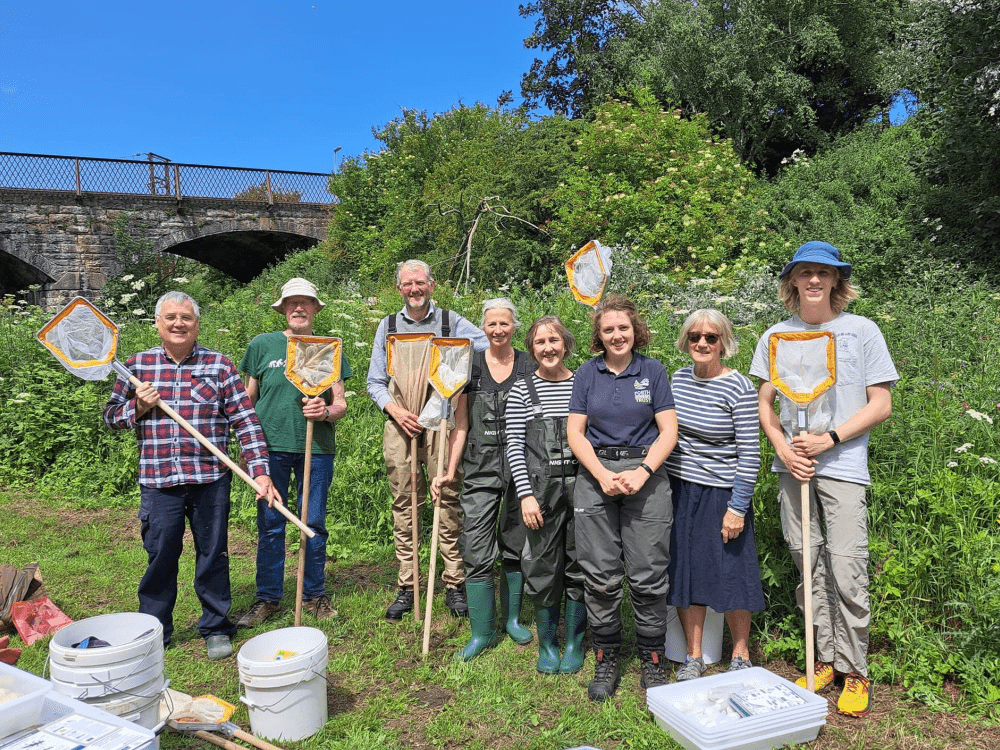
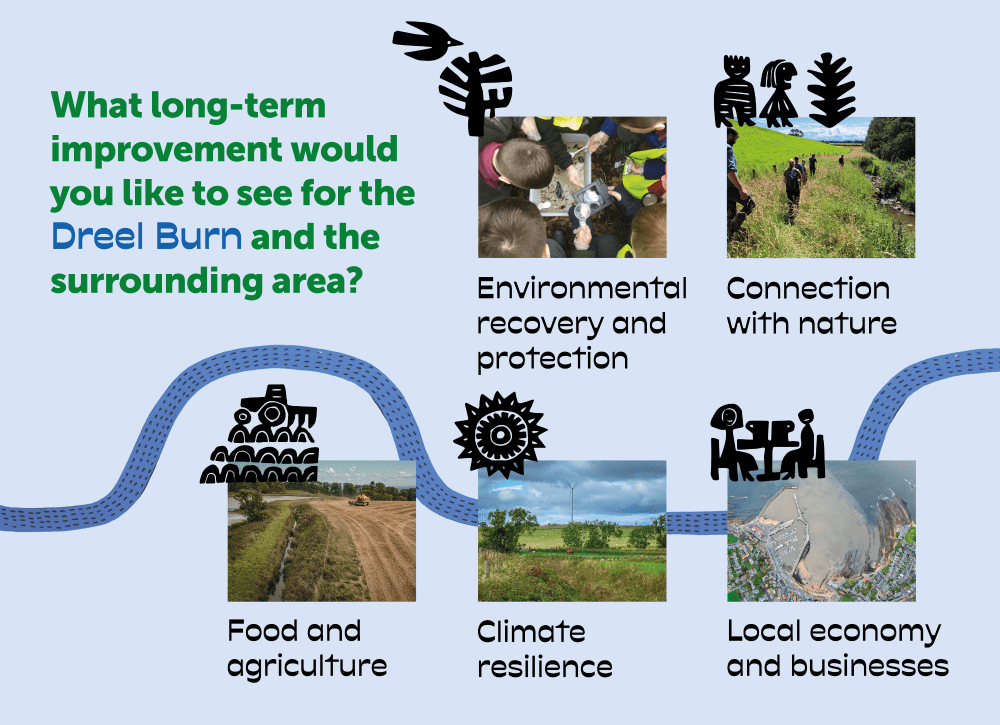
- Monthly Riverfly monitoring and chemical water testing (routinely mobilising up to 11 volunteers), delivering three years' of vital baseline data on phosphate, nitrate, ammonia and other metrics
- National programmes including RSPB Big Garden Birdwatch, Earthwatch's Great UK Water Blitz, and a Gaelic River Walk as part of Seachdain na Gàidhlig / World Gaelic Week
- Litter picks, cyanotype workshop, moth identification, tree care sessions, owl box installation
- Educational activities: Dreel Burn River Explorers workshop for children, Fish in the Classroom
- Outreach: Community River Session, Bowhouse Food Market, Green Teen Careers Fayre, University of St Andrews Transition Winter Fayre, Rewilding Kinkell's Ceilidh for Nature
- Hands-on interventions: management of Himalayan Balsam, bulb planting, meadow planting, scything
- Volunteer training in the Riverfly Monitoring Initiative's basic and extended riverfly programmes
- Two newsletters distributed (October 2025: 113 views; February 2026: 112 views)
Community organisations engaged with include: Fife Coast & Countryside Trust, Footprint East Neuk and the Dreelside Woods Community Asset Transfer, Anstruther Primary School, University of St Andrews, Rewilding Kinkell, Buglife, James Hutton Institute, Forth Rivers Trust, Transition University of St Andrews, and Kilrenny, Anstruther and Cellardyke Community Council.
The AIA has successfully fostered a highly active community science cohort. Monthly Riverfly monitoring and chemical water testing (routinely mobilising up to 11 volunteers) has already delivered three years of vital, localised baseline data on phosphate, nitrate, ammonia and other metrics, to infer diffuse and point pollution levels in the Dreel Burn. This data directly justifies our proposed interventions — including the proposed c.85 km hedge network designed specifically for intercepting diffuse pollution from agriculture — and is contributing to a research project run by the University of St Andrews Biology Department as well as to Buglife's Guardians of the River Riverfly Monitoring Initiative.
Rooted in the local community, the AIA can call on its extensive network to engage with other local organisations, such as community councils, other environmental groups working in the catchment, the local authority, academic and education providers, and local businesses, to maximise opportunities for consultation and to engage those who need to know about the project and can contribute to it.
The AIA has a strong track record in community consultation and will always consult with the local community before taking any significant action. An example of this is the recent volunteer biodiversity action in the Anstruther Wester graveyard, which was only undertaken following effective consultation, a presentation to the community council, and negotiations with Fife Council. We also undertook a community consultation process on our proposed planting plan to enhance the habitat at the mouth of the Dreel Burn, to promote biodiversity.
Through SAC Consulting, we have contacted all key landowners and managers within the catchment, providing them with the opportunity to engage with the partnership. We have actively engaged with these landowners through on-farm visits, one-on-one discussions and advice, farm transition plans, and farmer meetings. This has not only helped us develop a pipeline of investible projects, but also ensures that landowners have had the same opportunities to engage with the partnership.
Communities specifically engaged in project design and implementation include: Anstruther, Arncroach, Dreelside, and the broader East Neuk of Fife.
Capturing and Sharing Learning to Scale Markets
The Dreel Burn meta-pilot is serving as a critical "Case Study" for the Scottish Government's upcoming Ecosystem Restoration Code (ERC).
We have tested the applicability of credit mechanisms — including NARIA, a Scottish Biodiversity Metric, UKCCC, Wilder Carbon and ONCRA — that could work in intensive agricultural systems. We have synthesised our operational models into replicable "Menus" for farmers, demonstrating how complex blended finance (combining anonymous philanthropic CAPEX, State FGS subsidies, and voluntary corporate biodiversity funding for OPEX) can be orchestrated practically at the farm gate.
Through platforms like the Scottish Nature Finance Pioneers basecamp community, FCCT is actively sharing strategic insights gained during Phase 3 — specifically regarding the navigation of the new 2026 EFA rules and the restructuring of forestry densities to maximise both flood-defence (pluvial interception) and biodiversity outcomes.
The Nature Finance Fife portfolio is fundamentally designed to deliver the outcomes mandated by Scotland's Biodiversity Strategy — moving beyond isolated conservation to restore ecosystem function at a catchment scale. This transparent knowledge-sharing ensures that the Nature Finance Fife blueprint can be exported to catchments across Scotland.
Jobs Created
- 1 Direct Role Created: Dreel Burn Project Worker
- 15+ Estimated Long-term Rural Skills Roles: hedgelaying, specialist fencing, ecological monitoring, and cooperative management
Prototype Tools & Apps Developed
To aid engagement with Fife farmers, support project developers, and communicate opportunities to local buyers, the project has created a number of prototype webpages, tools and apps (specific app development was self-funded; content creation was FIRNS 3-funded), all designed to work on desktop and mobile with minimal internet connectivity requirements. They are in a test phase and are kept up to date at trigrammatic.com/en/work/nature-finance:
Evaluation — Finance
Finance Evaluation & Investment Readiness
Investment Status
The project is in active exploration and negotiation with multiple buyers and investors, including a targeted Phase 1 biodiversity pilot for the woodland restoration at Durie Farms, a local ONCRA carbon contribution partnership, and a >£1.1m CAPEX negotiation with a private philanthropic donor.
Our projects are now available for investors and buyers to review on NatureScot's Nature Investment prospectus: Durie Farm, Balcaskie Estate and Fife Climate Forest.
Natural Capital Mechanisms Explored
Through detailed engagement and collaboration, we explored the following live and operational schemes and applied them to ground-truth potential against Dreel Burn intervention proposals:
Code Agnostic Framework
Our work has helped us arrive at a decision to continue the development of a comprehensive, and holistic, set of interventions — with science-backed carbon sequestration profiles — through a full range of domestic and international schemes, including Woodland Carbon Code, UK Carbon Code of Conduct, Verra and ONCRA. We are exploring Kana for project registration and transparency. For further detail on ONCRA, see What is ONCRA? in the Learning section.
Barriers to Investment & Actions to Overcome
| Barrier | Actions to Overcome |
|---|---|
| Risks associated with entering into emerging natural capital markets | Reduce risks through blended financing. Case studies and peer-to-peer learning from pioneer farms. |
| Long tie-in periods and prescriptive management requirements | Greater flexibility in both interventions permitted and the management of these interventions. Shorter tie-in periods, or flexibility to withdraw (e.g. payments staggered over a timeframe). |
| Government backed natural capital mechanisms (WCC and PC) are restrictive with respect to interventions viable in intensive agricultural settings | Greater options of government backed codes including a woodland water code, hedgerow carbon code. |
| High land value costs and income forgone for land taken out of production in productive agricultural landscapes | Clear routes to blended financing approaches for a range of interventions (e.g. public streams including AECS, Nature Restoration Fund). Greater flexibility in interventions permitted and tie-in periods. |
| Lack of regulatory markets for biodiversity limiting buyer demand | Consider potential regulatory vehicles that could drive demand (e.g. BNG, Nutrient Neutrality, Polluter Pays). |
| High MRV Costs | Statutory biodiversity metric provides a baseline approach. In these landscapes there is also potential for broader approaches such as regenerative agriculture scorecards or farmer-led habitat quality assessments to facilitate adaptive management. Multi-metric approaches such as the NARIA framework should only be adopted where the market mechanism secures sufficient funding and they do not detract from on-the-ground action. |
| Complexities, legalities and costs associated with entering into natural capital markets — particularly prohibitive for smaller land holdings | Hands-on knowledgeable expertise. Standardised legal agreements to meet a variety of circumstances (e.g. owned and tenanted farms). Cooperative to enable smaller farms to enter markets. |
| Unknowns further increasing risk | Unknown future market demand — will prices rise? Unknown future supply chain demand — will farms have to demonstrate Net Zero and if so who 'owns' the carbon? Risks associated with projects failing to meet expectations (e.g. woodland or hedgerow failing to establish due to drought). Tax implications including inheritance tax. Effect of NC projects on agricultural subsidies for 'productive land'. |
Key Policy Observations
Current government-backed codes with clear blended finance routes focus on a relatively constrained set of actions (woodland creation and peatland restoration). These actions may not be applicable to lowland agricultural landscapes (e.g. lack of peatlands) or may not be economically viable due to loss of productive land.
Environment Bank & Biodiversity Offsetting
Our work with Fife Council and an infrastructure partner on exploring the feasibility of an Environment Bank and voluntary biodiversity offsetting yielded an important insight: biodiversity offsetting, even through an established compliance market (which does not yet exist in Scotland), will not generate a sufficient quantity of credits in Fife to be 'scaled up' as a reliable mechanism for funding nature restoration at scale across Fife. This means that neither a dedicated Fife Environment Bank nor Natural Capital Producers Cooperative can be formed around this particular market opportunity.
FCCT has, however, established a strategic relationship with Fife Council planning department, and is now actively supporting the council to locate suitable projects for developers involved in live planning applications to fund offsite compensation of onsite biodiversity loss.
Evaluation — Learning
Key Challenges, Learning & Additional Benefits
Natural Capital Producers Cooperative
At the outset of the project our investment thesis was that NFF would comprise a Natural Capital Producers Cooperative, an Environment Bank, and a trusted lead project developer (Fife Landscape Resilience Centre), supported by a menu of intervention types provably deliverable within a primary agricultural context, with demonstration 'trades' with three prospective buyers: carbon contribution, biodiversity offsetting and supply chain insetting.
The key challenges to reaching a decision point to establish the cooperative were the formation of a farmer-led working group (achieved, through the leadership of Durie Farms, Balcaskie Estate and Balbirnie Home Farms) and a clear value proposition for members based on an immediately addressable market. NCPC working group members had particular interest in exploring the potential to cooperate on soil carbon.
Early exploration of the NCPC focused on understanding what could be learnt from the Environmental Farmers Group and North East Cotswold Farmers in England, and looking at the potential relevance of the cooperative model through discussions with other FIRNS projects — in particular the Moray Cluster and River Annan project — as well as more recently the Caerlaverock Cluster, and a new cluster development activity in the East Neuk driven by Kinkell Byre.
We examined the opportunity to sell soil carbon through the UK Carbon Code of Conduct (UKCCC) and identified two significant barriers to participation: the high cost of baselining, and the requirement for a farm business to be 'net zero' before it could sell its soil carbon credits.
Landscape Enterprise Networks (LENs)
We have explored and learnt about a whole range of 'value propositions' for farmer-led collaboration and methods to aggregate supply. This included engagement with, assessment and analysis of: the LENs offering (evolving during this time thanks to the FIRNS-funded Leven LENs project), the Moray Farming Cluster, the Caerlaverock Cluster, the River Annan Restoration Project, North East Cotswold Farmers, the Environmental Farmers Group, and Regenerate Outcomes.
During Phase 3, the Nature Finance Fife team jointly presented with the LENS team at the Scottish Forum on Natural Capital, outlining our two complementary approaches. This was a helpful occasion for the NFF team to better understand the LENS offering and its implications for our project. With the FIRNS-funded LENS work in the Leven (Perthshire) having potential to extend into Fife, our planned engagement with a food manufacturer on supply chain insetting was deprioritised during Phase 3, to avoid unhelpful duplication of efforts. Supply chain analysis has instead identified a small number of food and drink processors and retailers sourcing from the catchment as the most relevant organisations to engage with in respect of the Dreel Burn in Phase 4.
Given the adoption of the LENS model by major drinks-sector buyers, and a much clearer understanding of the LENS offer, one area for exploration in Phase 4 will be to understand how FCCT can work with LENS on new prospective farming clusters.
Wilder Carbon — Assessment & Outcome
To accelerate understanding of the Wilder Carbon opportunity, an accredited project developer was engaged to prepare a registration of 'in scope' interventions. This exercise raised helpful feedback from two leading participants (Durie Farms and Balcaskie Estate). In both cases, the Wilder Carbon approach was deemed unsuitable, for different reasons:
- Concerns over the length of covenant and restrictions on how land could be managed and how nature restoration could take place
- The restrictive nature resulted in divergence between viable actions and the proposed goals that the farmer had for natural capital restoration
- Necessity to 'cookie cut' parts of the plan into Wilder Carbon, while leaving other interventions (with strong biodiversity and carbon value) outside the plans
The larger-scale woodland creation and high-distinctiveness scrub corridors originally proposed for Balcaskie Estate were scoped for this Wilder Carbon registration, which has since been set aside. Balcaskie Estate is now developing wood pasture, silvopasture and agroforestry concepts, alongside mixed native and wet woodland proposals that may be smaller in scale than before.
This 'cookie cutting' issue, through talking to other FIRNS projects, is not uncommon. However, given the need to secure sufficient funding to overcome high 'income foregone' concerns, adding a high baselining and MRV burden through having to work with multiple credit mechanisms on the same land broke the feasibility of this approach — even for an individual estate, let alone an entire catchment.
We did consider whether the cooperative itself, by establishing as a 'single legal entity' to register one project across multiple landholdings, could reduce the MRV burden. This was considered technically feasible and a potential value proposition for the cooperative. However, recognising the additional constraints identified by landowners, we did not pursue this line of enquiry further.
Regenerate Outcomes
While exploring ways in which the cooperative might support soil carbon baselining, the team was introduced to a well-developed offer by Regenerate Outcomes (originally NEIRF-funded), who have a free baselining and mentoring programme for farmers, using Verra to develop agroforestry and soil carbon credits. Inclusion in the RO programme requires a farmer's commitment to transition to regenerative farming practices — an approach considered so strong and comprehensive that it was difficult to identify what additional value an NCPC offer anchored on soil carbon could add. Transition to regenerative agriculture may also require a systems-level shift and, in some instances, considerable capital investment — for example, fencing and watering points in arable fields to allow livestock integration.
Ongoing discussions are underway on how FCCT can collaborate with Regenerate Outcomes in Fife.
What is ONCRA?
The outcome of our evaluation of carbon credit mechanisms has been to include ONCRA (Open Natural Carbon Removal Accounting) as one of the options for financing our comprehensive and holistic set of interventions, backed by science-backed carbon sequestration profiles suited for Fife. Of the mechanisms we have assessed to date, ONCRA is the one that can cover all types of interventions within a single farm and across a catchment, reducing the burden of having to register through multiple credit mechanisms. ONCRA has applied to the Integrity Council for the Voluntary Carbon Market (ICVCM) for CCP-Eligible status; at November 2026 that assessment is in progress.
We are exploring Kana for project registration and transparency, with the aim of digitising ONCRA registration and MRV processes to make them accessible and scalable.
As ONCRA allows one project to cover many intervention types, we do not anticipate an immediate need for a 'single legal entity' to register one project across multiple landholdings. Rather, we anticipate that connected projects can achieve collective visibility through a shared registration platform — retaining individual farm autonomy while presenting a coherent, catchment-scale portfolio to investors and buyers.
Demand & Market Conditions
As experienced by other FIRNS projects, demand has remained weak over 2025/26, with various political and economic headwinds compounding this situation. The team has therefore invested efforts in building the supply, gaining momentum amongst the agricultural community in Fife, and focusing on developing relationships with local 'buyers', including the farming estates themselves, who have a greater level of interest and stake in the Fife landscape.
Through baselining farms across the catchment, key threats to the wider supply chain include loss of pollination services, degradation of soil health, nutrient enrichment of watercourses, and impact of climate change — in particular periods of drought which could impact on water abstraction licensing in the future (water scarcity is a key risk to the Dreel Burn).
Additional & Unintended Benefits
The project team has brought together expertise in natural capital finance, natural capital market mechanisms, agroecology and agronomy. This collaboration has been vital to engage with the diversity of farmers in the catchment, and to build trust and increase understanding on the aims of the project and the role that farm businesses play as suppliers of natural capital.
ERC Meta-Pilot — Acting as a Case Study
The project has been supporting the Scottish Government's upcoming Ecosystem Restoration Code (ERC) by exploring:
- What constraints/opportunities does the updated strategic purpose for the ERC pose for agricultural landscapes like the Dreel?
- What are the strengths/limitations of NARIA and the Scottish Biodiversity Metric for operation in more intensive agricultural systems?
- What are the potential options to blend finance in productive agricultural landscapes, and the implications of blending private financing with AECS funding (additionality, governance, MRV)?
- How would revised eligibility criteria work for the Dreel, especially for collaborative projects across ownership boundaries?
- What opportunities does aggregation of sellers provide (risk reduction, cost reduction, larger projects for investors, co-designed landscape-scale action)?
- What barriers are there to collaborative project design and administration?
Project Outputs
Shareable Project Outputs
The following outputs have been produced during Phase 3 and are available to download or request from FCCT:
- Production of 16 Farm Transition Plans which outline the current natural assets, identify key actions to protect, restore and enhance these assets, and outline benefits of implementing these actions with respect to farm resilience, nature, carbon and water quality and resources
- Dreel Burn Catchment Interventions Map (including Balcaskie Estate)
- Scoonie Burn Interventions Map
- Biodiversity Audits for 16 farms compliant with the Whole Farm Plan
- Prototype digital tools and apps (in a test phase):
Community Benefits Proposed
- Increased regional drought and flood resilience
- Improved water quality
- Enhanced public access and amenity (15km of routes) with associated benefits to human health and wellbeing
- Rural skills development
- Creation of green jobs and volunteering opportunities
- Educational integration (Fish in the Classroom)
Looking Ahead — Phase 4
Next Steps & Maintenance Plans
Phase 3 has concluded with an identified project pipeline and a clear plan of action to operationalise Nature Finance Fife (NFF) — the subject of the Phase 4 application.